High Contrast Black and White Animal Photos and What They Reveal in the Wild

Updated: Feb 11
High contrast black and white animal photos have a way of stopping people in their tracks. The shadows are deep, the highlights are clean, and there is nowhere for the eye to escape. In black and white wildlife photography, this contrast strips an image back to its core. What remains is light, form, and behaviour. Over years in the field, I have found that high contrast black and white animal photography often reveals more truth than colour ever could. This is also why I choose to release these images as limited edition black and white animal prints for sale, allowing collectors to live with that raw, honest moment long after it was captured.

What makes high contrast black and white animal photos so powerful
High contrast black and white animal photos rely on a strong separation between light and dark. Deep blacks sit confidently next to bright highlights, with very little mid tone softness. This creates images that feel bold and intentional.
In wildlife photography, this contrast is rarely artificial. It comes from harsh sun, dust in the air, and animals moving between light and shadow. These conditions are common in places like the African savannah, where many dramatic black and white animal photos are born naturally.
I firmly believe this is why monochrome wildlife photography works so well in high contrast conditions. It reflects the environment honestly rather than softening it.
Learning to see light through field experience
Seeing contrast is not something learned on a screen. It comes from time spent outside, watching how animals move through light. In my own work, I look for moments where an animal enters light rather than trying to follow it constantly.
I have watched elephants walk out of shadow into bright sun where every crease in their skin becomes visible. I have created lion photographs where only the eyes and mane catch the light, leaving the rest of the body in darkness. These high contrast wildlife images are not planned in detail. They are recognised in the very moment it happens.
That awareness comes from experience and patience, not settings or presets.

Working with natural light in black and white wildlife photography
High contrast black and white wildlife photography depends entirely on natural light. Early mornings and late afternoons are ideal, but strong contrast can appear at any time when the light is directional.
I often choose my position based on where the light will fall rather than where the animal currently stands. This approach allows the scene to unfold naturally. When the animal moves into the right light, the photograph already exists. I simply record it.
This mindset is essential for creating fine art black and white animal photos that feel grounded and real rather than constructed.
What contrast reveals about animal behaviour
Contrast does more than create visual drama. It reveals behaviour.
A cheetah stepping into light with muscles outlined by shadow shows readiness and focus. A leopard resting in darkness with only its eyes visible communicates awareness and restraint. In these moments, black and white animal photography removes distraction and directs attention to intent.
These are real moments from the wild. They are brief and often quiet, but high contrast allows them to speak clearly.

From the wild to fine art black and white animal prints
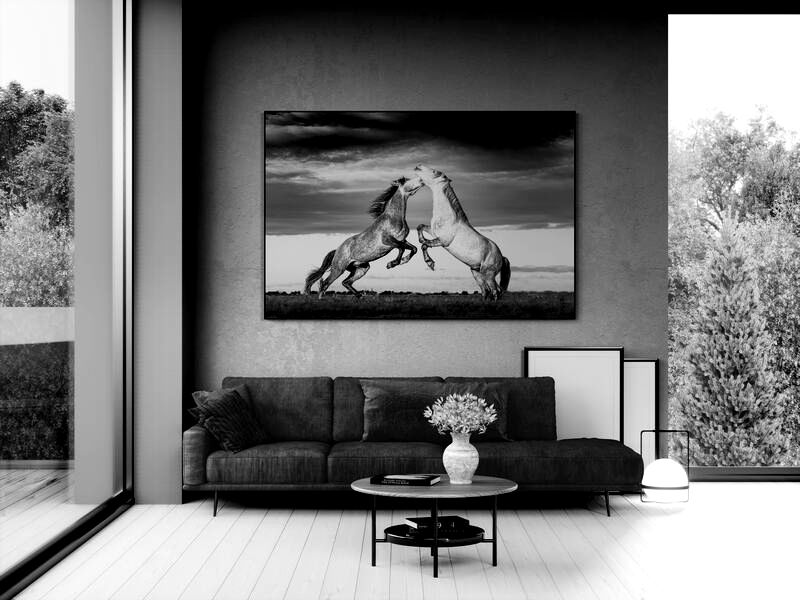
High contrast black and white animal photos translate exceptionally well into fine art prints. Strong tonal separation gives an image presence on a wall. The blacks anchor the photograph, while highlights guide the viewer through it.
When preparing fine art wildlife photography prints, I refine contrast carefully to reflect the original scene. The goal is not impact for its own sake, but honesty. The final black and white animal prints should feel the way the moment felt when I stood there.
This is often why collectors connect deeply with black and white wildlife photography. The images feel timeless and emotionally direct.
A personal approach to monochrome wildlife photography
My approach to monochrome wildlife photography is shaped by respect for the subject and the environment. I do not chase dramatic light. I wait for it. The contrast seen in my images comes from real conditions and real encounters.
Every photograph begins with observation. Dust, wind, silence, and distance all play a role. High contrast black and white animal photos are not created quickly. They are earned through time in the wild.
Why people connect with high contrast wildlife images
People often tell me that high contrast wildlife images feel more personal. Without colour guiding the emotion, viewers bring their own experience into the photograph. The image becomes a conversation rather than a statement.
That connection is what matters most to me. Whether seen online or as a fine art wildlife print, the photograph should feel honest and grounded.
High contrast black and white animal photos do not soften the wild. They respect it.
A note for collectors and those living with wildlife art
For collectors, high contrast black and white animal photos often connect on a deeper level because they are not only decorative. They are also deliberate. They carry weight and presence in a space. Without colour, the photograph becomes quieter but more demanding. It asks to be looked at rather than glanced over.
When someone chooses one of my black and white animal prints, they are not just choosing an image of an animal. They are choosing a real moment shaped by light, patience, and time spent in the wild. These photographs come from standing still while the world moves, from observing behavioural patterns rather than staging it, and from letting the conditions guide the final image.