Lion Roar: What It Means and Why It Is One of Africa's Most Powerful Sounds

The sound of a lion is called a roar or a growl.
A lion roar can travel up to 8 kilometres (5 miles) across the African savannah under ideal conditions.
Both male and female lions roar, but males usually produce the deepest and loudest calls.
Lion roaring is most common at dawn, dusk and during the night when lions are most active.
The powerful lion sound helps lions defend territory, reunite with pride members and warn rivals.
After years of photographing wild lions in Tanzania and Kenya, I have found that hearing a lion roar sound is often even more unforgettable than seeing the lions themselves.
There are few wildlife experiences that stay with you like hearing a lion roar in the wild. Even before you see the animal, the sound tells you something important is happening. It carries across the landscape, rolls through the grasslands, and instantly reminds you that you are in the territory of one of Africa's top predators.
After spending many months creating photos of lions across the Serengeti and the Masai Mara, I have heard this sound countless times. Every roar is different.
Sometimes it is a single deep call before sunrise. Other times it becomes a chorus as several lions answer one another across the plains. Watching these moments unfold has given me a deeper appreciation for what a lion roar really means.
Did you know?
Many people recognise the famous roaring lion at the start of MGM films. Surprisingly, the roar used in the modern logo is largely made from tiger vocalisations rather than a real lion. Sound designers found that tiger roars sounded more dramatic for cinema, even though they were paired with a lion on screen.
What does a lion roar mean?
A lion roar is far more than a loud noise. It is one of the main ways lions communicate over long distances. Depending on the situation, the roar can serve several different purposes.
A male lion may roar to announce his presence and warn rival males to stay away. Females often roar to help members of the pride locate one another after hunting or moving through thick vegetation. Roaring also strengthens social bonds within the pride, especially after periods of separation.
Unlike many other big cats that rely heavily on scent marking or silent movement, lions are highly social animals. Their vocal communication reflects this unique lifestyle.
Researchers estimate that a lion roar can be heard from as far as 8 kilometres (5 miles) under the right conditions. On cool, still mornings, the sound seems to travel almost endlessly across the African savannah.
Lion Roar Fact | Details |
Maximum distance | Can be heard up to 8 km (5 miles) in ideal conditions |
Typical volume | Around 114 decibels at close range |
Who roars? | Both males and females, although males usually produce deeper, louder roars |
Main purpose | Territory defence, pride communication, locating family members, warning rivals |
Best time to hear it | Dawn, dusk and during the night |
Duration | Usually lasts between 30 and 60 seconds, made up of several individual roars and grunts |
Frequency | Low-frequency sounds help the roar travel long distances |
Why it sounds so deep | Specially adapted vocal cords and larynx produce powerful, resonant calls |
Do lions roar every day? | Not necessarily. Roaring depends on territory, nearby rivals, pride movements and social interactions |
Why is it important? | Roaring reduces the need for physical confrontations by advertising a lion's presence from afar |
Why is a lion roaring mostly heard at dawn and dusk?
If you have been on safari, you have probably noticed that lion roaring is most common around sunrise and sunset.
These cooler hours are when lions become most active. They often patrol their territories, search for other pride members, or prepare for hunting. Roaring at these times helps establish their location before the day's activities begin.
Some of my most memorable mornings in Tanzania have started long before sunrise. Sitting quietly in the vehicle with only the faint outline of acacia trees visible, the first lion sound often breaks the silence. Within seconds another lion answers from the opposite direction. Then another. Before long, the entire landscape feels alive without seeing a single animal.
Those moments remind me that lion photography is not only about what we see. It is also about what we hear and experience.
How loud is a lion roar?
The volume of a lion roar is astonishing.
Scientists have measured some roars at around 114 decibels when heard close to the source. That is similar to standing near a rock concert or a chainsaw. More impressive than the volume is the low frequency of the sound, which allows it to travel over remarkable distances.
When you experience a lion roar sound from a nearby pride, you do not only hear it through your ears. You feel it in your chest.
Even after years of photographing lions and other wildlife, it still catches me by surprise every time.
What makes the lion sound so powerful?
Several physical adaptations allow lions to produce such an impressive vocalisation.
Their vocal cords are broader and flatter than those of most mammals. Combined with a specially adapted larynx, this allows them to generate extremely deep and powerful sounds without placing excessive strain on their voices.
This is one reason why the lion sound is instantly recognisable, even to people who have never visited Africa.
It is not simply loud. It has a deep resonance that very few animals can match.
Misconception: Not Every Open Mouth Means a Roar
One of the most common misconceptions is that every time a lion opens its mouth wide, it is about to roar. In reality, lions yawn just like domestic cats do. A yawn is a normal behaviour linked to tiredness, relaxation, or social bonding within the pride. During a safari, you may even wait days hoping to hear a lion roar, only to watch it yawn dozens of times instead. While a roar is a loud vocalisation used to communicate over long distances, a yawn is completely silent and serves an entirely different purpose.

The Flehmen Response Is Not a Roar
Another behaviour that is often mistaken for a lion roar is the flehmen response. When a lion detects an interesting scent, especially the urine of a female in oestrus, it may curl back its upper lip, wrinkle its nose, and hold its mouth slightly open for several seconds. This unusual facial expression allows scent molecules to reach the Jacobson's organ (also called the vomeronasal organ) on the roof of the mouth, helping the lion analyse chemical signals. Although it may look dramatic, the flehmen response is completely silent and has nothing to do with roaring. It is simply a way for lions to gather more information about scents in their environment.

Do both male and female lions roar?
Yes, although male lions usually produce the loudest and deepest roars.
Their larger body size and more developed vocal anatomy create the classic roar that many people associate with African safaris. Female lions also roar regularly, particularly when communicating with cubs or other pride members.
One of the most fascinating experiences I have witnessed was listening to an entire pride respond to one dominant male. The sequence continued for several minutes as individuals answered each other from different directions. It was impossible to know exactly where each lion was hidden until the first rays of sunlight revealed them emerging from the grass.
Those are the kinds of encounters that shape many of my photographs, even when the roar itself cannot be captured in a still image.
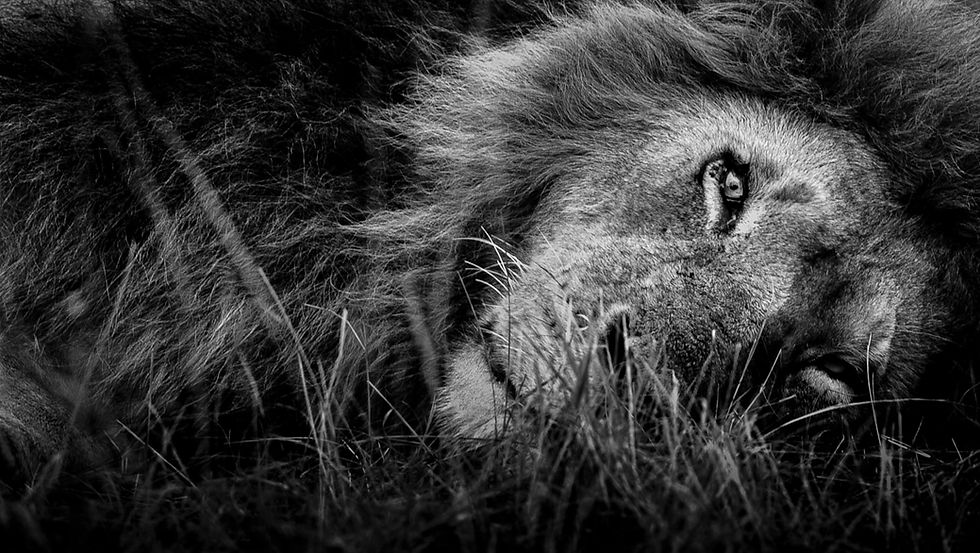
As someone who creates black and white lion photos, I often find that remembering the atmosphere of these moments helps me decide how to process an image. A photograph can never reproduce sound, but careful use of light, contrast and composition can still communicate the same feeling of strength and presence.
Lions do not roar as often as you might think
Films and documentaries often give the impression that lions are roaring constantly. In reality, that is far from the truth. You can spend days on safari, or even an entire trip, without hearing a single lion roar. Lions spend much of the day resting quietly and only roar when they need to communicate with other pride members or advertise their presence to rivals.
From my own time photographing lions across Tanzania and Kenya, I have learned that the silence is part of what makes the experience so special. A pride may rest peacefully for hours, or even days, without making a sound. Then, without warning, a single lion roar can roll across the plains and completely change the atmosphere. Because roaring is relatively uncommon, hearing it in the wild is something you are unlikely to forget.
Why hearing a lion roar changes the safari experience
Many people dream of seeing lions during their first safari. Fewer realise that hearing them can be even more memorable.
A roar creates anticipation. It makes you search every shadow and every patch of grass. It reminds you that Africa is still wonderfully unpredictable.
Some of my favourite sightings have actually begun with sound rather than sight. A distant roar tells the guide where to drive. Minutes later, you may find a pride resting on a kopje or a coalition of male lions walking confidently across the plains.
Those real moments from the wild often become the foundation for my fine art wildlife photography. Every image carries memories that extend far beyond the single frame.
When collectors choose one of my limited edition wildlife prints, they are not simply buying a photograph. They are bringing home a genuine moment that unfolded naturally in Africa, often accompanied by the unforgettable sound of roaring lions somewhere beyond the camera.
Can you identify individual lions by their roar?
Experienced researchers who spend years following the same prides often recognise subtle differences in individual roars. Factors such as age, size and health all influence the sound.
For photographers and safari guests, however, the roar usually serves another purpose. It tells us where to look and reminds us that something extraordinary may be about to happen.
It is one of the reasons I continue returning to the Serengeti year after year. No two mornings are ever the same.
Whether I am photographing a dominant male on a granite kopje or creating new lion wall art for collectors around the world, those early morning roars remain part of every memory.
Final thoughts on the lion roar
A lion roar is one of nature's greatest sounds. It communicates territory, family, strength and survival across the African landscape.
Having spent countless hours with wild lions in Tanzania, Kenya and South Africa, I have come to appreciate that the roar is often just as meaningful as the sighting itself. It creates tension, excitement and a deep connection to the wild long before the lions come into view.
For me, those authentic experiences continue to inspire every photograph I create. Each image is rooted in real time spent with wild animals, patient observation, and respect for their natural behaviour. That connection is what I hope viewers feel when they experience my black and white wildlife photography, whether they have heard a lion roar themselves or are discovering its power for the very first time.