Famous Lions: The Most Legendary Lions in Africa

Updated: Jul 28
Some famous lions become legends because of their size. Others because of their remarkable stories, impressive coalitions or the places they called home. A few have even inspired documentaries, conservation projects and generations of wildlife photographers. Having spent many weeks photographing lions across Kenya and Tanzania, I have learnt that every well-known lion has a unique personality. While lion photos often capture a single moment, spending days with the same individual reveals habits, behaviours and character that you simply cannot appreciate in one encounter.
Whether you are planning a safari, researching iconic African lions or simply fascinated by these magnificent predators, these are some of the most famous lions ever to roam Africa.
Famous lions in Kenya
Craig - Maasai Mara, Kenya (Male, Deceased 2021)
Scarface - Maasai Mara, Kenya (Male, Deceased 2021)
Notch - Maasai Mara, Kenya (Male, Deceased 2013)
Bibi - Maasai Mara, Kenya (Female, Deceased 2015)
Kali - Maasai Mara, Kenya (Male, Deceased, Year unknown)
Lipstick - Maasai Mara, Kenya (Male, Deceased 2018)
Long'Oipa - Amboseli , Kenya (Male, Deceased 2022)
Morani - Maasai Mara, Kenya (Male, Deceased 2024)
Tsavo Man-Eaters - Tsavo, Kenya (Male, Both Deceased 1898)
Kamunyak - Samburu, Kenya (Female, Last Documented 2004)
Famous lions in Tanzania
Rasta - Serengeti, Tanzania (Male, Alive)
C-Boy - Serengeti (Male, Deceased 2018)
Bob Jr. (Snyggve) - Serengeti (Male, Deceased 2023)
Tryggve - Serengeti (Male, Deceased 2023)
Famous lions in Other CountRies
Rasta – The Golden King of Namiri Plains
Male, Alive
Rasta is one of the best-known lions in Tanzania's Namiri Plains. Together with his coalition partners, Rolo and Kaka, he forms the famous Golden Boys, one of the most photographed lion coalitions in the Serengeti today.
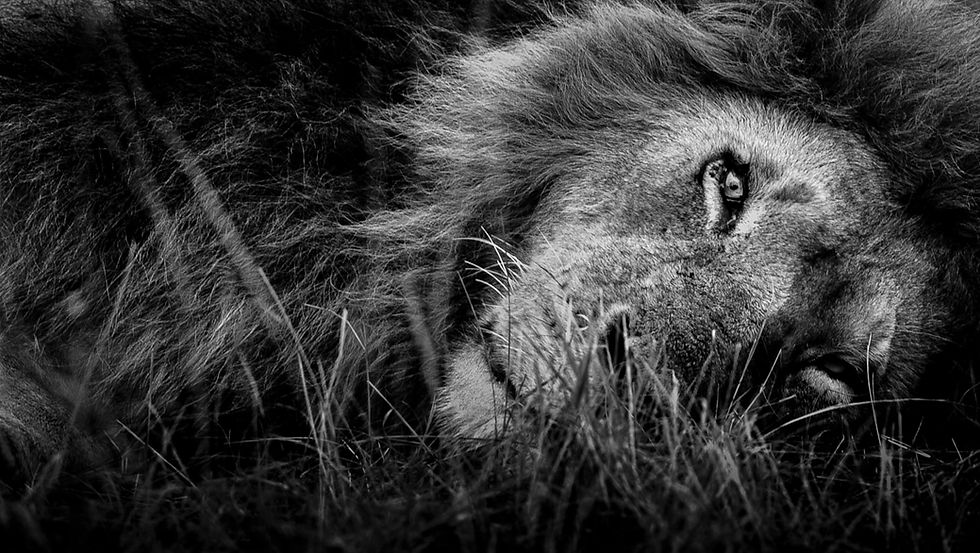
His striking golden mane, calm temperament and distinctive facial markings have made him a favourite among wildlife photographers. During my own time photographing him in Namiri Plains, what stood out most was not his appearance but his confidence. He carried himself with complete ease, allowing us to observe natural behaviour without ever feeling rushed. Those quiet moments often create the strongest images, especially in black and white animal photography, where expression and posture become even more important than colour.
At the time of writing, Rasta remains one of the Serengeti's most recognisable male lions.
The Golden Boys coalition, consisting of Rollo, Rasta and Kaka, are, by some, believed to descend from the famous Bob lineage and are commonly described as sons of Bob Junior (Snyggve), although their exact paternity has never been scientifically confirmed. One of my favourite lion photos of all time is of Rasta.
Craig – The King of the Marsh Pride
Male, Deceased 2021
Few famous lions captured the hearts of safari guides, photographers and wildlife enthusiasts quite like Craig. Born around 2008, he became one of the most recognisable lions in Kenya thanks to his immense size, dark mane and calm, confident personality. Unlike many dominant males that disappeared after only a few years, Craig ruled his territory for well over a decade, earning a reputation as one of the Maasai Mara's greatest lions.
Craig was primarily associated with the Oloololo Escarpment and the north-western Maasai Mara, where he was regularly photographed by visitors from around the world. Despite countless territorial battles throughout his life, he remained an impressive and resilient male well into old age. His distinctive appearance and relaxed behaviour around safari vehicles made him a favourite subject for wildlife photographers. Seeing Craig had long been one of my personal goals, but sadly he passed away in January 2021 before I had the opportunity to photograph him.
Craig died from injuries sustained during a territorial conflict at around 13 years of age. Although he is gone, his legacy lives on through the countless photographs, documentaries and memories he inspired, cementing his place as one of the most iconic lions ever to roam the Maasai Mara.
Scarface – The Warrior of the Maasai Mara
Male, Deceased 2021
Few famous lions have captured the imagination of safari-goers quite like Scarface, also known simply as Scar. Living in Kenya's Maasai Mara National Reserve, Scarface became instantly recognisable thanks to the large scar over his right eye, the result of a territorial fight that nearly cost him his vision. Rather than slowing him down, the injury became part of his identity. Together with his coalition partners, Morani, Sikio and Hunter, he formed the legendary Four Musketeers. In 2011, they defeated Notch and his coalition to take control of the famous Marsh Pride, beginning one of the Mara's most memorable reigns.
Scarface was photographed countless times and appeared in numerous wildlife documentaries, becoming one of Africa's best-known wild lions. He died in 2021 at an estimated 14 years of age, leaving behind a remarkable legacy. Around 2018, the ageing Four Musketeers gradually lost their territory to the powerful Six Pack, also known as the Bila Shaka Coalition, made up of the six brothers Baba Yao, Doa, Chongo, Kiok, Kibogoyo and Koshoke. Together, they ushered in the next chapter of the Maasai Mara's remarkable lion history, continuing the ever-changing succession of dominant coalitions that has made the reserve one of the best places in the world to follow the lives of individual wild lions.
Notch – The Patriarch Who Shaped a Generation
Male, Deceased 2013
Long before lions like Scarface and the Four Musketeers became icons of the Maasai Mara, another extraordinary male had already left an unforgettable legacy.
Notch is regarded as one of the most influential lions in the history of the Maasai Mara. Named after the distinctive notch in his ear, he became the dominant male of the famous Marsh Pride and fathered an extraordinary number of cubs during his reign. Many of the Mara's best-known lions can trace their lineage back to Notch, making him one of the most genetically influential males ever recorded in the ecosystem. He died in 2013, but his bloodline continues to shape lion populations throughout the reserve. His story remains one of the greatest examples of how a single dominant male can influence generations of lions and leave a lasting mark on an entire ecosystem. In 2011, Notch and his coalition were eventually dethroned by Scarface and the rest of the Four Musketeers, who took control of the Marsh Pride.
Bibi – The Heart of the Marsh Pride
Female, Deceased 2015
Bibi was one of the most recognisable lionesses ever featured in the BBC series Big Cat Diary. Born around 1998, viewers followed her life for nearly two decades, watching her raise cubs, overcome hardships and remain a central member of the famous Marsh Pride. She became known not through dramatic battles or dominance, but through her resilience and the intimate story of her life that millions of viewers came to know. In December 2015, Bibi was tragically poisoned after feeding on a cow carcass laced with pesticide following livestock conflict near the Maasai Mara. Her death shocked wildlife lovers around the world and highlighted the ongoing challenges of human and lion coexistence.
Kali – A Master of Survival
Male, Deceased Year unknown
Kali is one of the better-known lions of the Maasai Mara and earned a reputation through resilience rather than sheer size. Throughout his life he survived numerous territorial disputes while helping defend his coalition's territory. Guides often recognised him by his distinctive facial features and confident behaviour around safari vehicles. Although he has never received the same international fame as Scarface or Notch, Kali remains a lion that many returning visitors to the Mara still remember.
Lipstick – The Lion with the Unforgettable Face
Male, Deceased 2018
Some lions are remembered because of dramatic battles. Lipstick is remembered because of his appearance. His nickname comes from the dark pigmentation around his mouth, giving the impression that he is wearing lipstick. Living in the Maasai Mara, he has become a favourite subject for photographers thanks to his unique facial markings and relaxed behaviour. His distinctive features make him one of the easiest lions to identify in the field, proving that not every famous lion needs a dramatic story to become well known.
Long'Oipa – The King of Amboseli
Male, Deceased 2022
Long'Oipa was one of the best-known lions of Kenya's Amboseli ecosystem. Named after the Maasai word for "big beard," he was recognised for his impressive dark mane and commanding presence. He became a symbol of the Amboseli lion population and featured in several conservation stories over the years. Long'Oipa's life highlighted the challenges faced by lions living alongside local communities, where conservation depends on balancing the needs of both wildlife and people.
Morani – Strength in the Coalition
Male, Deceased 2024
Morani was one of the famous members of the legendary four-male coalition that included Scarface, Hunter and Sikio. Together they dominated large parts of the Maasai Mara for many years and became some of the most photographed lions in East Africa. Morani was often recognised by his broad face and impressive mane, but it was the coalition's teamwork that made these lions truly remarkable. Watching coalition males interact offers a fascinating insight into lion society, where cooperation can be just as important as individual strength.
Cecil – The Lion Who Changed the World
Male, Deceased 2015
Perhaps no lion has had a greater impact on global conservation than Cecil. Living in Zimbabwe's Hwange National Park, Cecil was already well known to researchers before his illegal killing in 2015 made international headlines. The event sparked worldwide debate about trophy hunting and raised millions for lion conservation projects. Although his story ended tragically, Cecil became a powerful ambassador for Africa's wildlife and helped introduce millions of people to the challenges facing wild lion populations.
The Tsavo Man-Eaters – Lions That Built a Legend
Male, Both Deceased 1898
The Tsavo man-eaters are among the most famous lions in history. In 1898, during the construction of the Kenya-Uganda Railway, two male lions were blamed for killing dozens of railway workers near the Tsavo River in Kenya. Their story inspired books, documentaries and the Hollywood film The Ghost and the Darkness. Although historians continue to debate exactly how many people they killed, the Tsavo lions remain one of the most extraordinary chapters in Africa's wildlife history. Their preserved skins can still be seen at the Field Museum in Chicago.
Kamunyak – The Lioness Who Adopted Oryx Calves
Female, Last Documented 2004
Kamunyak became one of Africa's most extraordinary lionesses after repeatedly adopting young oryx calves instead of hunting them. Living in northern Kenya during the early 2000s, she displayed behaviour that surprised scientists and attracted worldwide media attention. Although the calves rarely survived for long, her repeated acts of apparent maternal care challenged long-held assumptions about lion behaviour and made Kamunyak one of the most famous lionesses ever recorded.
Casper – The White King of Kruger
Male, Alive
Casper is undoubtedly South Africa's most famous living lion. This striking white male roams the Satara region of Kruger National Park, where his rare leucistic coat has made him instantly recognisable around the world. Despite concerns that his unusual colour would put him at a disadvantage, Casper has thrived in the wild, successfully hunting, defending territory and becoming one of the most photographed lions in Africa.
C-Boy – The Lion Who Refused to Give Up
Male, Deceased 2018
Few famous lions have demonstrated the resilience of C-Boy (also known as Bob Marley). Born around 2004 in the Seronera region of the Serengeti, he became one of Tanzania's most celebrated male lions after surviving a brutal attack by three rival males that left him with devastating injuries. Against all expectations, C-Boy recovered and returned to reclaim his place in the Serengeti, earning worldwide admiration from researchers, safari guides and wildlife photographers alike.
Over the years, C-Boy was photographed extensively and became one of the best-known lions in East Africa. Beyond his remarkable survival story, he also left an important legacy through his offspring. He fathered Bob Junior, also known as Snyggve, and Tryggve, two of the Serengeti's most famous brothers. C-Boy died in 2018, but his story remains one of the greatest examples of resilience ever recorded in a wild lion.
Bob Junior (Snyggve) – The King of the Serengeti
Male, Deceased 2023
Father: C-Boy Bob Junior, often known by his Swedish nickname "Snyggve", became one of the most photographed lions in Tanzania. Born around 2012 or 2013, he inherited his father's impressive appearance and ruled Namiri Plains alongside his brother Tryggve for several years. His enormous black mane and commanding presence earned him the title "King of the Serengeti", making him a favourite subject for photographers from around the world.
In March 2023, Bob Junior was killed during a territorial takeover by a coalition of younger rival males. Like many dominant lions before him, his reign eventually came to an end, illustrating the constant cycle of competition that shapes life on the African plains. His photographs continue to inspire wildlife enthusiasts and remain among the most recognisable images of a Serengeti lion.
Tryggve – The Loyal Brother
Male, Deceased 2023
Father: C-Boy Tryggve was the brother and lifelong coalition partner of Bob Junior (Snyggve), and together they became one of the Serengeti's most formidable lion duos. Born around 2012 or 2013 to the legendary C-Boy, the brothers inherited both their father's impressive size and their striking dark manes. While Bob Junior often attracted more attention, Tryggve played an equally important role in defending their territory across Namiri Plains.
The brothers ruled together for several years, patrolling one of Africa's richest predator ecosystems and becoming favourites among safari guides and wildlife photographers. In 2023, Tryggve was killed during the same wave of territorial takeovers that claimed the life of Bob Junior, marking the end of one of the Serengeti's most celebrated lion coalitions.
Why Famous Lions Matter
Every famous lion tells a much bigger story than its own life.
These individuals become ambassadors for entire ecosystems. They encourage tourism, inspire photographers and help raise awareness for conservation across Africa.
As a wildlife photographer, I have learnt that spending time with individual lions changes the way you see them. Instead of simply photographing "a lion", you begin recognising personalities, relationships and behaviours that make every encounter unique.
Many of my favourite lion photographs have come not from dramatic hunts, but from quiet moments shared with animals like Rasta in the Serengeti. Those experiences continue to inspire both my photography and my collection of lion fine art prints, where the goal is not simply to decorate a wall but to bring a genuine connection with Africa's wildlife into people's homes.
If you are passionate about wildlife, planning a safari or looking for timeless wildlife wall art, I hope these stories encourage you to look beyond the photograph and appreciate the remarkable lives behind each image.